Drivers seeking a new convertible car now face the fewest options in decades, as manufacturers prioritise SUVs and electric vehicles, according to analysis. Online marketplace CarGurus described open-top cars as an “increasingly rare sight”.
The study found the 30 UK car makers offer just 11 new convertible models collectively, a sharp drop from 29 models six years ago and the 37 available at the segment’s 2005 peak.
Recent cuts include BMW reducing its range from five to two models, Porsche dropping the 718, and Jeep ceasing to offer any. Despite the industry’s shift to electrification, fully electric convertibles remain rare, with only two models on sale in the UK.
Conversely, demand for used convertibles is increasing, with average prices up 10% year-on-year to around £18,000, CarGurus reported.
The company’s UK editorial director Chris Knapman said: “For years, convertibles were a core part of many manufacturer line-ups, and they brought character and desirability to a brand’s range.
“Today, they’re becoming an increasingly rare sight as carmakers focus investment on SUVs and electrification.
“Demand for open-top motoring clearly hasn’t disappeared.
“Used convertible prices are rising, and there’s still strong enthusiasm for cars that get the wind in your hair as part of a more evocative driving experience.”
Steve Gooding, director of motoring research charity the RAC Foundation, said: “Brits have a long-established love affair with convertibles.
“The fact that prices for these models in the used car market are staying strong suggests that it’s not drivers but the auto companies who are changing tack, perhaps because they are playing to the global market and see soft top vehicles as too much of a GB niche.
“Perhaps drivers craving a wind-in-the-hair experience will have to switch to cars with a panoramic sunroof, while convertible devotees continue to seek out the sportier models still being produced by small volume companies.”
For the United States’ 250th birthday, Sunday Morning asked dozens of notable Americans, from Jason Alexander and Ken Burns to Misty Copeland, what they considered to be our country’s essential songs. This is the Essential American Songbook: 90 contributors and 250 songs. Here’s a sample.
Astronomers have uncovered a pair of giant planets that are lighter than cotton candy — super-puffs the size of Jupiter.
The featherweight pair — orbiting a star 1,110 light-years away — are the biggest exoplanets found to have less density than cotton candy.
That makes them the lightest known planets of their size, said the University of Oxford’s George Dransfield.
“These two planets have densities comparable to a nice blob of shaving foam, fresh from the can,” Dransfield said in an email. She and her team reported their findings Wednesday in Monthly Notices of the Royal Astronomical Society.
Dransfield suspects these fluffy, wispy worlds are probably white or blue, depending on whether the skies there are cloudy — not shades of cotton-candy pink. The planets are probably mostly hydrogen and helium, although it will take follow-up observations by NASA’s Webb Space Telescope to confirm their chemical makeup.
Detected by NASA’s Tess satellite over the past decade, these two especially puffy puffs orbit a star in the southern constellation Volans, known as the flying fish. The researchers studied the planets’ orbits using telescopes on Earth to determine their density, from 1,110 light-years away. A light-year is nearly 6 trillion miles.
This illustration provided by NASA depicts the Sun-like star TOI-791, background left, and two giant planets that NASA’s TESS space telescope discovered in its orbit.
Daniel Rutter/NASA via AP
In 2024, researchers found a super-puff planet 1,200 light years from Earth, calling it a “cosmic mystery.”
Jupiter, by comparison, is as much as 35 times denser than these two lightweights.
The newly found planets also have unusually long orbits, with one taking 139 days and the other taking 232 days to circle the host star, NASA said in a news release.
Considered rare in the cosmos, super-puffs are thought to form around the disk of gas and dust around a newborn star where there is more gas than dust. They shed much of the material over time, stripping down even more.
“The main reason these planets are interesting to study is that we didn’t expect to see them at all,” said Jon Jenkins, the science lead for the Science Processing Operations Center at NASA’s Ames Research Center in California’s Silicon Valley. “They represent a puzzle for us to solve about how giant planets like Jupiter and the super-puffs form.”
NASA’s tally of worlds outside our solar system currently stands at nearly 6,300 confirmed. Fewer than 40 are super-puffs, according to Dransfield.
“Ultimately, by studying exotic systems containing rare planet types, we add further pieces to the puzzle of planet formation and learn more about our place in the cosmos,” she said.
The European Space Agency’s Euclid space telescope has delivered one of the most detailed views ever captured of our galaxy’s crowded heart, revealing more than 60 million stars in a single extraordinary image. The observation offers astronomers an unprecedented look into the densely populated central regions of the Milky Way, a part of the galaxy that has long remained difficult to study because of thick clouds of dust and overlapping stellar populations. Beyond its visual impact, the image represents a scientific treasure trove that researchers expect to analyse for years, if not decades. By mapping stars, star clusters and hidden galactic structures on an enormous scale, Euclid is providing fresh clues about how the Milky Way formed, evolved and continues to shape the cosmic environment around us.
How Euclid captured 60 million stars in the crowded heart of the Milky Way
Launched in 2023, Euclid was designed primarily to investigate the mysterious dark universe, including dark matter and dark energy. However, its powerful instruments are also proving exceptionally valuable for studying our own galaxy.The newly released image focuses on the Milky Way’s central bulge, a densely packed region containing vast numbers of stars concentrated around the galactic centre. According to the European Space Agency, Euclid observed an area covering approximately 500 square degrees of the sky and detected more than 60 million stars, many of which had never been studied in such detail before. “With a single observation, Euclid has captured millions of stars, demonstrating its extraordinary ability to survey vast regions of the sky in remarkable detail,” ESA stated.The telescope’s visible and near-infrared instruments allow it to peer through dust that often obscures observations from Earth, revealing stellar populations hidden deep within the galaxy.
Why astronomers believe the Euclid image will fuel discoveries for decades
The significance of the image extends far beyond its sheer scale. Researchers expect the dataset to help identify previously unknown star clusters, trace the structure of the galactic bulge and improve understanding of stellar evolution.ESA scientists note that the immense catalogue will provide opportunities to investigate how stars are distributed throughout the Milky Way and how different populations formed over billions of years. Because the image contains tens of millions of objects, researchers anticipate years of detailed analysis and follow-up studies.The mission’s advanced imaging capabilities are particularly valuable for detecting faint objects that might otherwise remain hidden among brighter neighbouring stars. This could lead to discoveries ranging from previously overlooked stellar nurseries to rare astronomical phenomena.According to Euclid science team at the European Space Agency: “These observations provide an unprecedented view of the Milky Way’s central regions and will support a wide range of future scientific investigations.”
What Euclid’s Milky Way map reveals about the future of space research
Although Euclid’s primary objective remains understanding the large-scale structure of the universe, its observations are increasingly demonstrating their value for galactic astronomy.By combining visible and infrared observations, the telescope can build detailed maps of stellar distributions, helping scientists reconstruct the history of our galaxy. Researchers hope these observations will shed light on how the Milky Way assembled over cosmic time and how interactions with smaller galaxies influenced its development. The image also highlights Euclid’s ability to produce datasets on a scale rarely achieved in astronomy. As additional observations are collected throughout the mission, scientists expect even larger catalogues and more comprehensive maps of the universe.For astronomers, the release marks more than a striking snapshot of the cosmos. It is the beginning of a long-term scientific resource that could reveal new insights into the Milky Way for decades to come, helping answer some of the most fundamental questions about our place in the universe.
UK drivers are being cautioned that it will take “some way to go” for fuel prices to align with the significant drop in oil costs, which have now returned to pre-Middle East conflict levels.
The AA reports that the average price for a litre of petrol at UK forecourts stands at 152.9p, with diesel at 170.5p.
While these figures are below the April 16 peaks of 159.7p for petrol and 192.4p for diesel, motorists are still paying approximately 20p more for petrol and 28p more for diesel than before the conflict began.
This disparity comes as the price of oil, a key determinant of fuel costs, dipped below 73 US dollars a barrel for the first time since the Iran war commenced on February 28.
This comes as more tankers pass through the crucial Strait of Hormuz, which is reopening gradually after the US-Iran peace deal.
AA president Edmund King said: “While drivers have been pleasantly surprised by the speed of price falls at the pump, there is some way to go before prices return to where they were before the outbreak of the war.”
Oil prices have dropped to levels last seen before the war in the Middle East as the crucial Strait of Hormuz reopens gradually following the US-Iran peace deal (Alamy/PA) (Alamy/PA)
Mr King claimed some drivers will fear “prices could go the other way” because of “uncertainty” over the future actions of Iran and the US.
He added: “The hope is that pump prices continue to tumble with the summer getaway late in July now coming into view.”
Hopes of a lasting peace agreement between Washington and Tehran continue to improve market sentiment. Progress in negotiations has encouraged more oil tankers to resume voyages through the strategically vital Strait of Hormuz, easing concerns over supply bottlenecks.
Shipping data indicates traffic through the waterway has rebounded strongly. According to MarineTraffic figures reported by CNN, vessel movements through the Strait of Hormuz doubled over the past 24 hours to reach their highest level since late February.
Brent crude, the international benchmark, dropped as low as $72.24 a barrel on Thursday, slipping beneath the $72.48 closing price recorded on the eve of US and Israeli strikes against Iran in late February.
Priyanka Chopra opens up about how motherhood has changed her
Priyanka Chopra has opened up about how her life has changed after becoming a mother.
For those unversed, the Bollywood diva tied the knot with Nick Jonas in 2018, and the couple welcomed their daughter, Malti Marie, on January 15, 2022, via a surrogate.
Speaking at the Cannes Lions conference on Wednesday, Priyanka said, “Your priorities really change. I don’t just pack my bags and go off for a movie anymore.”
“I don’t do five films a year. I don’t travel the way I used to,” she continued. “I’m really, really selective about the time I spend and who I spend it with.”
The Heads of State star added, “I’m navigating working-mom life. I have so much more respect for my mother now.”
At the same conference, Priyanka also compared her Hollywood career to Bollywood success.
“In my Hindi-language career, I’ve worked with all the best filmmakers and the best actors, I’ve told amazing stories and done a variety of genres,” she said.
“Whereas in America, in Hollywood, in my English-language work, I haven’t really done that as much,” she confessed.
“My next reinvention is figuring out how, in (my) English-language work, I can bring that kind of variety to my characters that I have been able to do in India,” added the 43-year-old actress.
Tristan H. Cockcroft is senior writer for fantasy baseball and football at ESPN. Tristan is a member of the FSWA Hall of Fame. He is also a two-time LABR and three-time Tout Wars champion.
Multiple Authors
Fantasy baseball managers, on the whole, aren’t always quick to jump on a player’s stardom bandwagon.
Take last week’s top name profiled in this space, Jac Caglianone. He’s a player whose continued recent excellence provides the impetus for today’s column discussion. Since then, Caglianone has hit another six home runs — bringing his total to nine in 20 June games thus far — all of them traveling at least 400 feet. He’s now fifth among batting title-eligible players for the season in terms of hard-hit rate (58.5%), and 11th in Statcast’s Barrel rate (17.0%).
Yet, only in the past couple of days has Caglianone begun to move the needle in ESPN leagues, his roster rate jumping by more than 16% since Sunday (it’s 49.3% currently). Until now, he was the consummate 2026 example of the underrated fantasy baseball player.
Caglianone isn’t alone on any proverbial “all-underrated” list. The four names examined below also have absurdly low ESPN roster percentages, but warrant much more attention than they’ve attained to date.
This isn’t to say that any of the quartet’s statistical ceilings is equal to Caglianone’s, being that last week’s examination sought players with the greatest upside rather than simply underrated players. Still, every one of them is well worth acquiring in any fantasy league, and each could be as profitable a pickup as the Kansas City Royals slugger.
Only five qualified hitters this season have at least a .280 batting average, a .380 wOBA and a 15% Statcast Barrel rate: Yordan Alvarez, Nick Kurtz, Shohei Ohtani, Ben Rice … and Canzone. All of Canzone’s contact-quality metrics — Barrel rate, hard-hit rate, average exit velocity, etc. — have placed in the 80th percentile or better both this and last year, signaling he’s a much better hitter than you might think.
The fourth-year, 28-year-old outfielder might be regarded a strong-side platoon man, but credit the Mariners for giving him a chance to improve against lefties, as Canzone has made three starts against them over the past 10 days alone. Between this and last season, he’s a .263/.374/.355 hitter with a .331 wOBA against lefties, significant in that all lefty hitters during that time average a .295 wOBA against same-handed pitchers. If this is a trend, rather than “well, all our alternatives were hurt at the time” logic, Canzone’s ability to hold his own against lefties, coupled with his excellence against righties, might sum up to a top-20 fantasy outfielder.
Canzone’s rostership in ESPN leagues reached a career-high 18.0% on Saturday, only to drop by nearly 6% since after he left Sunday’s game due to a hamstring injury. It’s being regarded a minor ailment, so consider this an opportunity to add him in a wider scope of leagues or a trade window in deeper leagues where he’s already rostered.
play
2:58
How ABS is helping left-handed hitters dominate like never before
Remember this guy? The one who hit 25 home runs and made the All-Star team in his first full year with the Marlins in 2025? It sure doesn’t seem like you do, considering his rostership in ESPN leagues is about half what it was on Opening Day (28.7% now, 56.9% then). Oh, sure, his missing the first three-plus weeks due to a hamstring injury, then posting a sub-.600 OPS across his first 25 games, will do that. However, it’s hard to believe that a 28-year-old who had better-than-90th-percentile Barrel and hard-hit rates during said breakthrough 2025 would taper off statistically this swiftly.
The truth? He hasn’t, being that his seasonal hard-hit rate remains 95th-percentile — even his Barrel rate is a sound 70th — and since June began, he’s looking a lot more like his 2025 self, batting .229/.337/.529 with five home runs and top-15 numbers in terms of Barrel (20.5%) and hard-hit rates (56.8%).
Stowers continues to maintain his heart-of-the-order, everyday role, and he’s now getting time at first base due to the Marlins’ mediocre production there (as well as the injury to Liam Hicks), beefing up his positional flexibility. That the Marlins are scrappy and have on-base specialists they can place atop their lineup — Otto Lopez (.369 OBP), Xavier Edwards (.375) and Jakob Marsee (.324) have all seen time batting first or second — can only benefit Stowers in terms of RBIs.
His rostership in ESPN leagues has fluctuated following his hot-and-cold patterns to date, reaching 58.4% on May 12 but hovering near 45% since Memorial Day. Homers in back-to-back games on Sunday and Monday could suddenly make him a popular pickup this week. Should Okamoto remain available in your league, however, scoop him up now, being that his recent uptick in production could be more a signal of his getting settled in MLB, rather than just a mere hot spell.
To date, Okamoto has been very much as advertised: Good eye, demonstrated by his 75th-percentile chase rate (swing percentage at non-strikes); elite contact quality, as his 90th-percentile hard hit rate shows; good pop, reflected by his 91st-percentile Barrel rate. Despite this, he ranks only barely inside the top 20 third basemen in terms of fantasy points, largely because he has nearly three times as many strikeouts (100) as he did in his final year in Japan (36), in only two more trips to the plate (316 so far in 2026).
That penchant for whiffs might never disappear, but it could fade, being that, over the past five seasons, only three batting title-eligible hitters finished with as high a strikeout rate (31.6%) and wOBA (.345) as Okamoto has now: Javier Baez and Joey Gallo in 2021, and Brent Rooker in 2023, all of them definitively different hitters in style than Okamoto. Considering the Blue Jays’ offensive depth, boosting Okamoto’s runs and RBI potential, he could be on the verge of a second-half breakthrough.
Perhaps the sneakiest breakthrough candidate of them all this season is Roupp, whose 1.48 WHIP last season was eighth-worst among pitchers who made at least as many as his 22 starts. Rostered in only 26.0% of ESPN leagues, Roupp finds himself just outside the top 50 starting pitchers in terms of fantasy points, and his 3.00 FIP ranks 11th among the 63 who qualify for the ERA title.
What has made the difference for Roupp thus far has been better command of his sinker, which is generating 6% more ground balls and allowing 9% less hard contact than in 2025, which is helping making both his curveball and changeup shine. Both secondary pitches are getting 34% whiff rates or better and, naturally, he’s now in the upper half of the league in terms of his overall whiff and strikeout rates. Unsurprisingly, opponents are batting 31 points lower against him this year than last.
This isn’t to say that Cy Young votes, or even fantasy ace chatter, are in Roupp’s near future, but he’s quickly becoming a pitcher you’ll want in your lineup for all but his scariest of matchups (think Coors Field, Sutter Health Park, at the Los Angeles Dodgers, at the Milwaukee Brewers). That’s not someone you’ll often find available in as many leagues that he currently can be.
London’s schools, some decades or over a century old, are baking in 90-degree heat. In France, teachers have covered windows with blankets or chalk and let children play in water outside. Most students are just glad to kick off their shoes.
“I feel like I’m in an oven,” said one of them, Raya Petrova, 7, whose teachers were desperate to keep their London classrooms cool without air-conditioning. “It is really hot.”
Extreme heat is broiling much of western Europe, but class is still in session for millions of students in countries such as Britain and France, where few schools are air-conditioned. The heat has trapped education officials between trying to avoid school closures, which mean lost learning days, and the effects of high temperatures, which research shows can affect learning outcomes and test scores.
Until relatively recently, many European schools were somewhat protected from extreme heat because classes were mostly out by summer’s peak. British and French school years end in July, later than most U.S. schools but still before the most sweltering weeks of August.
Climate change is hitting Europe hard, and it is getting hotter sooner in the year. That means more intense heat at the end of the school year, with students often in aging buildings made to insulate against the cold, not keep cool in the heat.
“You’re putting kids in a greenhouse for six hours a day,” said Pete Lynch, the principal at Sheldon School in Chippenham, southwestern England. His state-funded school closed early on Tuesday and will stay closed on Wednesday and Thursday.
A school in Nantes, France, coated its windows with chalk powder in an attempt to keep students cool.Credit…Sebastien Salom-Gomis/Agence France-Presse — Getty Images
A fan at a bilingual school in London, on Wednesday.Credit…Kevin Coombs/Reuters
But, Mr. Lynch said, he had no alternative. The windows open no more than a crack. The school has only a few air-conditioning units, some of which cool servers, and there are just 50 fans for 60 classrooms, 20 of which he bought last week.
“The buildings aren’t designed for heat,” he said. “They aren’t designed for anything, really. When it’s cold, it’s freezing.”
Although the problem has worsened in Europe in recent years, schools have struggled to adapt.
Paris is buying 1,200 air-conditioning units to give out to 620 preschools and elementary schools, according to Mayor Emmanuel Grégoire. By Monday, the city had deployed just 150. In schools that have stayed open, teachers were loosening uniform rules to allow for cooler clothes and canceling gym classes.
Violaine Guéguen, who teaches in a Paris preschool, said the heat was almost unbearable. Parents were carting their own fans back and forth. The principal covered windows with blankets to keep rooms darker, and the faculty filled toy boxes with water and let students play with it in a shaded part of the courtyard outside.
“We can’t go on like this, constantly having to find D.I.Y. solutions ourselves,” Ms. Guéguen said. “We are bound to face more heat waves.”
The Belgian authorities issued a heat warning for most of the country from Wednesday until Friday, with temperatures set to exceed 35 degrees Celsius, or 95 Fahrenheit.
Several schools decided to suspend afternoon classes until the end of the week, while others are staying open but are replacing lessons with cooling activities such as outdoor water games, said David Janssens, a spokesman for the public education network of the Flemish Community. To escape overheated classrooms, one primary school, in the municipality of Hoegaarden, moved some classes to the air-conditioned conference rooms of local businesses, Joris Verbaeten, the mayor of Hoegaarden, said in a social media post on Monday.
The dilemma of whether to close schools has divided parents, teachers and education officials, resurrecting the polarized debates of schooling during the coronavirus pandemic.
“Obviously, it’s unsafe for them to be here,” said Emma Hergest on Tuesday, as she sprayed sunscreen onto the necks of her children — ages 9, 8 and 5 — before they went to school in London’s 92-degree heat.
Sheltering from the sun at a school in Grabels, near Montpellier, France on Tuesday.Credit…Gabriel Bouys/Agence France-Presse — Getty Images
Applying sunscreen at a “sun safety stall” at the elementary school in Grays, on Wednesday. Credit…Jack Taylor/Reuters
On Monday, the British Department for Education said it did not recommend school closures for the heat. “School attendance is the best way for pupils to learn and reach their potential,” the department said in a statement. “And hot weather can usually be managed safely.”
Many school leaders have to make their own calls.
In France, nearly 10,000 of the country’s 60,000 schools closed or changed their schedules this week because of the heat wave, Édouard Geffray, the education minister, told lawmakers.
Britain has no similar tally, the education department said in an email, but local news reports, school announcements and interviews with parents suggested that many schools were at least partly closing.
Closures have left many parents struggling to find child care even though homes or other settings may not present a better option for staying cool. “Who has air-conditioning in London?” said Dr. Silvia Pierini, a pediatrician in the city.
Adult supervision is an argument for keeping classes open, she said. “At least in school, there is control.”
Some parents have shrugged off the alarming headlines and heat warnings, saying they grew up in hotter places.
“It does make you laugh — kids go to school around the world,” said Claire Demetriou, 39, who has family in Greece.
Sofia Georgieva, 36, said she might need to find child care for her 7-year-old daughter. “When it’s too hot, there’s just no point to be there,” Ms. Georgieva said. “There’s no learning.”
But as a hairdresser, she added, she won’t get paid unless she goes to work. If school closed, she said, it left her with “a really tough decision.”
She would not be able to regularly take off work, she said, and she does not see officials or school leaders making real plans to prepare for extreme temperatures.
That feels like a structural problem, she said: “This country is not designed for the heat.”
Koba Ryckewaert contributed reporting from Brussels.
Corrected on
June 24, 2026
:
An earlier version of this article misstated the type of cooling products that Paris was buying for schools. They were air-conditioning units, not fans.
Kiley McDaniel covers MLB prospects, the MLB Draft and more, including trades and free agency.
Has worked for three MLB teams.
Co-author of Author of ‘Future Value’
Multiple Authors
Welcome to out first college baseball transfer portal rankings!
These rankings include all players who are currently in the portal or players who already committed to another school — I’m not including the future first rounders who never entered or any 2026-draft eligible players who didn’t commit to a school; George Washington C Robbie Lavey and Stony Brook LHP Micah Worley would be ranked if they had committed to a new school. I assume those players likely will sign pro contracts, and some of the 2026-eligible players who committed to schools might, too, but it’s hard to guess which ones.
Lastly, these players are ranked based on pro potential, not projected college contributions or the stats they’ve already put up. When you’re in the ACC or SEC, those things are all pretty similar, with age and physical projectability the big variables along with where you stand on the tools to skills spectrum. You can look at my previous draft rankings to know that 40+ FV tier is generally late-first round to early-second round, while 40 FV tier takes you through the fourth round or so and the 35+ FV tier down to about $200,000 bonuses, spread throughout the draft.
There’s some standout college performers who have fastballs sitting in the high-80s or bottom-of-the-barrel raw power with good feel for the game who aren’t on here, but will be good college players next year. Some players will improve over the next 12 months and jump above players on this list, but this is how I would grade these players if they were tossed into this year’s draft class.
The college baseball transfer portal is open from June 1-30.
Top portal classes
Texas only has three commits, but those players rank first, fourth and 18th overall, so it is bringing in immediate impact talents. LSU similarly is shooting for the stars, landing my fifth-, eighth-, 10th-, 27th- and 60th-ranked players, with only one commit not making this list. Mississippi State has also landed five players on this list, while Texas A&M has landed, with the Aggies adding some solid depth just off of this list. Arizona State has landed three players, two or whom are on this list, while North Carolina and Georgia Tech are also reloading effectively. South Carolina, Tennessee, Arkansas, TCU and Oklahoma round out the baker’s dozen of schools in total pro prospect value added in the portal.
40+ FV Tier
1. Ian Armstrong, C, 2027 draft-eligible Transferring from: St. Mary’s Transferring to: Texas
Armstrong hit 16 home runs in 2026 and he has the above average raw power to do it again next season in the SEC. He’s an above average framer who should be able to stick behind the plate long-term, and he has roughly average contact/on-base skills. With some expected progress next season, he should land in the top two rounds of the MLB draft.
Savoie was a standout freshman at Loyola Marymount who moved to Clemson in the portal at this time last year due in large part to a 20-home run season and plus raw power. His exit velos were even a notch better in 2026, going deep 16 times for Clemson, but the Tigers failed to make the NCAA tournament. Savoie has some chase concerns at the plate and he split time mostly between catcher and left field so his defensive eval behind the plate is incomplete.
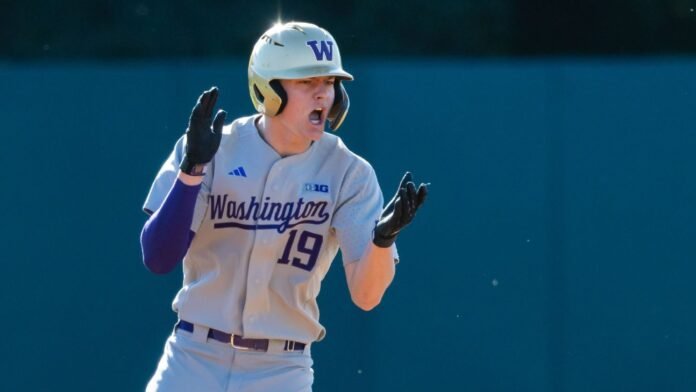
3. Jackson Hotchkiss, LF, 2027 Transferring from: Washington Transferring to: Arizona State
Hotchkiss was a late helium name in the 2024 draft out of high school whose price wasn’t met, then his sophomore year with the Huskies was his breakout: 20 home runs with 65-grade raw power. His 26% strikeout rate is a concern, as his uphill path gives Hotchkiss real in-zone miss issues, but his pitch selection is good and his in-game power ability is the selling point. He’s a solid runner and defender in left field, so I don’t think he’ll move out of the top two rounds if he keeps producing like this, even with the strikeout rate and left field profile.
40 FV Tier
4. Linkin Garcia, SS, 2027 Transferring from: Texas Tech | Transferring to: Texas
5. Bino Watters, LF, 2027 Transferring from: Notre Dame | Transferring to: LSU
6. Jake Souders, RF, 2027 Transferring from: Samford | Transferring to: Mississippi State
7. Jamie Laskofski, SS, 2027 Transferring from: William & Mary | Transferring to: North Carolina
16. Trey Morris, LHP, 2028 Transferring from: Oregon State | Transferring to: Florida
17. Jay Abernathy, CF, 2027 Transferring from: Tennessee | Transferring to: Oklahoma
18. Sawyer Solitaria, RF, 2027 Transferring from: Kent State | Transferring to: Texas
19. Cayden Suchy, LHP, 2027 Transferring from: UConn | Transferring to: Florida State
Garcia had some interest out of high school (I ranked him 216th in the 2025 draft) and he performed well as a freshman, with his plus raw power and real contact skills could lead to a breakout next year, when he’s sophomore eligible. Souders has some of the best raw power in college baseball but has a little work to do tapping into it in games more often. Watters also has plus raw power with a more well-rounded skillset. I had never heard of Laskofski until I looked into portal names and he could find himself in the top two rounds like the Tar Heels’ last portal shortstop: Jake Schaffner in the upcoming 2026 draft. Hood was a sleeper freshman I stumbled upon later in the season, up to 97 mph and flashing a plus changeup; it’s not surprising LSU made him a priority.
60. Josiah Overbeek, LF, 2027 Transferring from: Army | Transferring to: Mississippi State
Lauaki entered the portal recently and has an extreme skillset: He may have 80-grade raw power with the feel to tap into it in games, but may also be a DH with almost off-the-charts in-zone miss. Voorhies was one of my projectable pitcher sleepers — he’s 6-foot-4 and another tick of velo while starting could put him in the early rounds — and UNC landed him before a potential breakout. My almost namesake McDaniel is a solid runner and defender with plus contact skills who just needs to get stronger to become an early-round option. Peeples was a prospect I liked out of high school (172nd in last year’s draft rankings) who didn’t play much as a freshman, and he could break out with more regular playing time. Espinoza is another sleeper on the mound with huge extension, good shapes and solid feel, with breakout potential if the velo keeps improving.