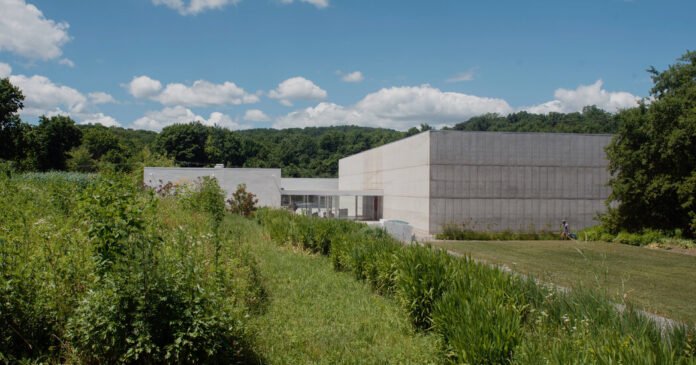
Up in Beacon, N.Y., art handlers were arranging dozens of little embroideries under the watchful eyes of the curator Matilde Guidelli-Guidi; 50 miles to the north, in Millerton, a painter named Karen Marston was painting an iceberg on the side of a barn: It was time for Upstate Art Weekend again. The five-day festival, which extends across 10 counties in the Catskills and Hudson Valley, is a chance for artists and art lovers beyond the metropolis to remind one another how large and vibrant their community really is — but it’s also the perfect excuse for city dwellers to hop on a train, or into a car, and work some fresh air and greenery into their lives.
This year’s big change, as the fair celebrates its seventh edition, is an online smart itinerary builder. Type in your preferences, from distance and direction to genre of art, and it will tell you where to go. But you can also just work the old-fashioned way, starting with a single landmark destination — like the newly renovated KinoSaito, an art center in Verplanck, or an exhibit of Richard Sandler’s street photography at the Capa Space in Yorktown Heights, or an architectural fantasia like Boscobel or the Lyndhurst Mansion — and work backward. These are some of the newer attractions that caught my eye.
The Boetti Corridor
In 1967, Alighiero Boetti (1940-1994) showed a group of opaque, strangely lush objects at Galleria Christian Stein in Turin, Italy. There was a small wooden platform on the floor, lit from underneath so that its bottom edge glowed, and a collection of beige PVC pipes arranged in a formal column. This work was some of what inspired the critic Germano Celant’s term Arte Povera, which would come to evoke minimal treatments of luxurious materials and willfully absurdist takes on important questions.
For Boetti, the important questions revolved around identity, authorship and the operations of chance. “Tutto Boetti: 1966-1993” at Magazzino Italian Art, the gorgeous little temple of Arte Povera in Cold Spring, starts with a formidable selection of those early works before leaping into algorithmic drawings and the quirky, beautiful embroideries the artist had fabricated by Afghan women in Kabul and Peshawar. There’s a map of the world, an enormous pattern of black and white checks and two endlessly delightful examples of what Boetti called his “Tutto,” or “everything,” series — brightly colored depictions of miscellaneous objects that send up the rationalist urge to catalog the world even as they recall nursery school décor. In the courtyard outside the gallery, when the wind is right, you can see steam rising from the head of a bronze self-portrait with a built-in heating element.
Up the road at Dia Beacon, the museum at 3 Beekman Street, “Alighiero Boetti” opens this weekend with a wall of embroidered text art, an elaborate arrangement of postage stamps and drawings that Boetti mailed to a gallery in Tokyo in 1980 and one especially memorable map in which the fabricators, left to their own devices, colored the sea bright orange. There’s something almost too perfect about this pair of similar but different shows for an artist who changed his name to “Alighiero e Boetti,” or “Alighiero and Boetti.” What makes it even more striking is that the museums didn’t coordinate — they planned their complementary exhibitions by accident. (There is, however, a docent- and curator-led tour of both shows starting at Magazzino at noon on Saturday. R.S.V.P. essential.)
The Kingston Cluster
A surprising number of Upstate Art Weekend’s most alluring events and exhibitions are clustered in and around Kingston, a two-hour ride from Manhattan by car or Trailways bus. In a single day, in Kingston alone, you could visit the second edition of Stay Frosty Kingston, the combination “tailgate, trunk show and art fair” founded last year in a Harlem parking lot by BravinLee Programs; take in a sprawling deep-dive into the possibilities of collage at 68 Prince Street Gallery, and the equally sprawling new Upstate Photography Biennial at CPW (formerly the Center for Photgraphy at Woodstock); drop in on indoor and outdoor sculpture shows at Front Room Gallery, a large exhibition curated by the festival’s founder, Helen Toomer, at UAW HQ (“Earthen Plot”) and another little art fair in the storefronts of a semi-abandoned mall — all before cleansing your palate with some high-design Fiesta ashtrays in the original six colors (1936-38) at the new International Museum of Dinnerware Design.
But make sure you’re properly caffeinated, because there are also several unmissable shows just across the river at Bard College in Annandale. In “Cagecircle: Composition for an Exhibition” at Stevenson Library, the John Cage Trust uses chance procedures to put together a group of miscellaneous objects, including a box of the maestro’s own piano “preparations” and a pair of embroidered silk suspenders. (Don’t miss a live re-enactment of his “Lecture on Nothing” at 1 p.m. on Saturday.)
At the Hessel Museum of Art, also at Bard, exhibitions of explosively colorful paintings by Uman, a prolific artist born in Somalia, and work by the Diné mathematician and textile artist Marilou Schultz hang alongside a survey for Betty Parsons (1900-82). Though she was best known as a gallerist who showed heavy hitters like Pollock, Rothko and Newman, Parsons was a dedicated painter herself, producing a distinctive body of abstractions in which forms like animal cells float across strangely fraught planes of unusual color.
Group Shows and Pop-Ups
What’s especially wonderful about a festival as far-flung as this one is just how many different communities it brings to light — and opens up to visitors. That’s most visible in the group shows and pop-up exhibitions.
Opening this weekend at The Campus, a former school complex in Claverack that is jointly operated by six New York galleries, is an annual large-scale summer show, this one featuring presentations of work by Tschabalala Self, Keith Haring, Pat Oleszko, Sarah Lucas and other famous names.
Glögg Glögg, a “pop-up art faire” in Woodstock, offers dozens of local artists selling affordable work, while Enlighten Peekskill, organized by Hudson Valley MOCA, showcases its formerly struggling Hudson Valley city with a mile-long path of illuminated sculpture.
“Seven Women Chase Icebergs” at the Re Institute in Millerton features climate-focused work by seven female artists who all worked together in Pouch Cove, Newfoundland, including Marston and her ominous blue berg.
Just about 12 miles south, in Wassaic, the artist Danielle Klebes’s Wassaic Motorcycle and Paint Club transforms an actual garage into a self-conscious painted environment.
On Saturday, the Carolee Schneemann Foundation will screen several of the artist’s experimental films and videos at the Widow Jane Mine, a historic cement mine in Rosendale, where some films were set.
“Freewheeling,” a group show of “unconstrained and spontaneous work” organized by the distinctly downtown artists Adrianne Rubenstein, Annette Wehrhahn and Meg Lipke, unrolls at Lipke’s studio in Ghent, with craft beer and wood-fired pizza from Old Klaverack Brewery to sweeten the deal.
Upstate Art Weekend
The fair runs from June 25-29. For a list of the organizations across the Hudson Valley and Catskills, exhibitions, programs and cultural spaces throughout the region, see upstateartweekend.org.